Why Your Marketing Content Should Match Your Sales Funnel
Effective content is one of the best ways to help convince potential guests to convert. The clearest way to create effective content? By having your content map to your sales funnel.
That’s the core insight behind what we call the Content-Funnel Connection: a strategic framework that maps what your customers actually need to see, at each stage of their decision process, against what you’re putting in front of them.
When content and customer journey align, something interesting happens: your sales funnel works better, your marketing ROI climbs, and your customer acquisition cost drops.
Here’s how to intentionally shape that content funnel so it consistently works for you.
What is lead generation really?
Before we talk about funnels, let’s be clear about what we’re building toward.
Lead generation is a four-stage process where content does specific work at each step:
- Build Awareness / Attract Prospects: People are dreaming and planning. They need to discover you exist and that what you offer is worth thinking about.
- Meet Interest / Educate: People are considering options. They need information that proves you understand their journey and can deliver what they want.
- Create Desire / Engage: People are narrowing their choice. They need content that makes your offer feel like the right one (social proof, specifics are key here).
- Inspire Action / Convert: People are ready to book. They need one clear reason to click, call, or complete that form.
Each stage needs different content. Feeding awareness-stage content to someone ready to book is like giving someone a map when they’re already at their destination.
Why Great Content Matters for Your Sales Funnel
Here’s what we see when content and funnel actually work together:
Lead generation is a four-stage process where content does specific work at each step:
- “Clicks that stick”: Better engagement because people find what they’re looking for at the moment they’re looking for it.
- Higher marketing ROI: You’re not wasting spend on the wrong message to the wrong person.
- Lower cost per customer acquisition: Aligned content moves people through the funnel faster, cutting waste.
- Better educated customers: Customers who are guided through the right educational content close faster and have fewer post-booking questions.
- Potentially faster booking cycles: When someone sees the right content at the right moment, decision time compresses.
This matters whether you’re spending $5K or $50K a month on marketing. Better content alignment is an immediate efficiency gain.

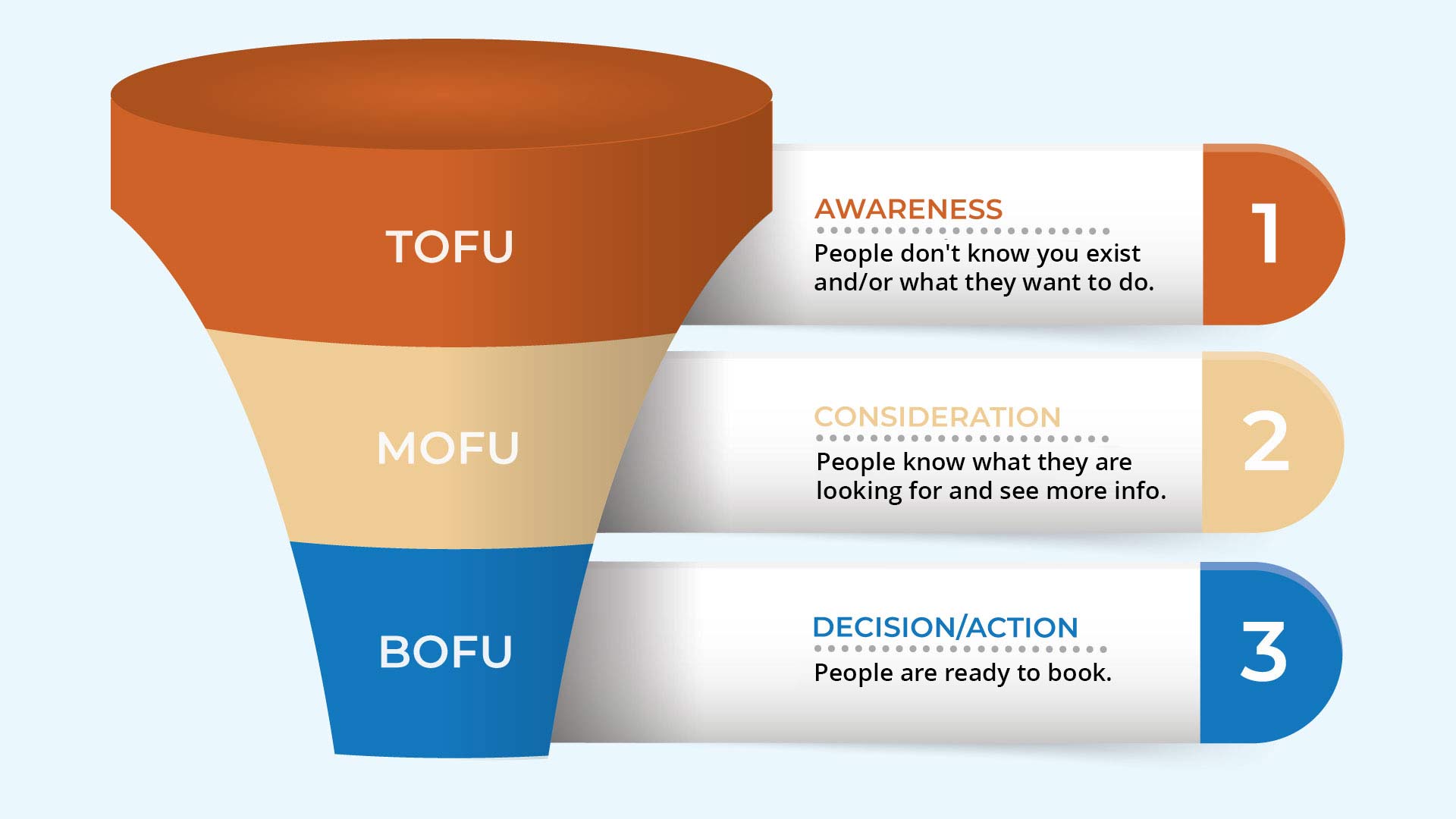
The TOFU/MOFU/BOFU Framework
We organize sales funnels into three sections, each with a specific job:
TOFU (Top of Funnel): Awareness Stage
These are your dream-stealers. People don’t know you exist yet, or they’re just starting to think about an adventure/experience in your space.
Content that works at TOFU:
- Educational and informational videos
- Direct events (video views, resource downloads)
- Blog posts that teach something useful
- Product web pages
- Compelling images and storytelling
MOFU (Middle of Funnel): Consideration Stage
People know what they’re looking for. Now they’re comparing options and building confidence that you’re the right choice.
Content that works at MOFU:
- Deeper educational content (podcasts, downloadable guides, detailed blog posts)
- Direct events (newsletter opt-Ins, account creation, gated content downloads)
- Product videos that show the real experience
- Testimonials about specific aspects of the trip to help show who can do it successfully, or reasons why the guest booked, etc.
- Resources, how-to guides, packing lists
- Print assets for events or direct mail
- Landing pages that clearly position your unique angle
BOFU (Bottom of Funnel): Decision/Action Stage
People are ready. They just need a push (urgency, a discount, a clear next step, or one more proof point).
Content that works at BOFU:
- Specific product videos with booking details
- Discount or timely offer ads
- Dedicated landing pages with clear CTAs
- Testimonial videos (still powerful, but different ones)
- Personal outreach
- Retargeting ads (to people who’ve already shown interest)
The mistake we see most often: companies load up on BOFU content (discounts, “Book Now” ads) and wonder why their funnel leaks at the top. Or they create all TOFU content (beautiful educational videos, inspiring stories) and never guide anyone to a booking page.
What Makes Content Effective (or Ineffective) for Your Funnel
Not all content works. Here’s what separates effective lead generation content from the kind that just sits there:
Every piece of content should include:
- An Emotional Hook: People don’t book based on facts alone. “Experience the majesty of the Andes” lands differently than “8,000-meter elevation trek.” Hook the feeling first.
- Education (The Right Amount): TOFU content can be more educational. BOFU content should be more clear/action-oriented. Match the education level to where people are in their journey.
- Inspiration: Even your how-to guides and discount ads should make people want what you’re offering. Inspiration is the thread that ties it all together.
- Clear Creative Direction: Who are people seeing in your ads? What are they doing? Stock photos of happy generic people don’t sell adventures. Real travelers, authentic moments, and compelling experiences do.
- A Specific Call to Action: “Learn More,” “Click Here,” and “Shop Now” are weak CTAs. “See Our Gear Checklist,” “Reserve Your Spot,” “Watch How We Pack” are specific. People respond to clarity.

How Your Customer Journey Maps to Your Sales Funnel
Here’s where it gets practical.
A typical adventure travel customer moves through three major phases:
Phase 1: DREAM & PLAN (TOFU/Awareness)
- Customers are asking “What adventures exist that match my interests/ability/budget?”
- Content they need: Educational and informational videos, blog posts, product pages, inspiring images
- Where to reach them: Social media, search (answers to early-stage questions on topics / keywords), organic content, communities
Phase 2: PLAN & BOOK (MOFU/Consideration)
- Customers are asking “Which operator should we book with? Is this trip worth it? What exactly will we do?”
- Content they need: Detailed product pages, podcasts, resource guides, testimonials, overview videos, packing lists, email education
- Where to reach them: Email, landing pages, retargeting, search (answers to specific questions on topics / keywords), your website
Phase 3: BOOK, EXPERIENCE & SHARE (BOFU/Action + Beyond)
- Customers are asking “How do I book? When? What’s the deal? Should I act now?”
- Content they need: Specific product videos, landing pages with clear booking paths, discount offers, testimonials, events, customer support
- Where to reach them: Direct email, paid ads (retargeting), landing pages, phone conversations, AI Assistants (generative AI chatbots)
The power here: if you map your actual content inventory against these three phases, you can see exactly what’s missing. Most companies have plenty of dream content (Phase 1) but are thin on consideration and action content (Phases 2 and 3). That’s your leak.
See exactly which stages of your funnel are leaking customers and what content is missing.
The AI Search Wildcard
If you’re wondering whether organic search still matters for lead generation: yes, but differently than it did two years ago.
Here’s what’s changed:
- Users are using AI tools, in addition to Google, to find search for answers to their questions. These tools may include ChatGPT, Microsoft Copilot, Claude, and Perplexity, as well as many other smaller platforms. And, don’t miss the fact that Google is now powered by its AI tool, Gemini.
- For Google searches, depending on the search topic, Google will serve sponsored ads first, or sponsored products, or the AI Overview. If ads show up first, there can appear up to four search ads before any organic result.
- AI Overview results are either the first or second section: “Best answers” Google’s AI pulls from multiple sources, with links.
- Organic search results are pushed down even further now. Users typically do not scroll this far for information anymore.
The upshot: organic keyword or topic ranking alone is no longer a dependable lead generation strategy. You need better answers to real users’ questions, than your competitors. You need content that any AI platform (be it Google, ChatGPT, or Copilot), pulls into their “Best Answers” section.
How do you win AI search? With the best content answers. The most comprehensive guide. The clearest explanation. The most useful resource. If your content is generic, AI won’t surface it. If it’s genuinely the best answer to a question, it will.
Putting It Together: An Action Plan
Here’s how to audit your own content-funnel connection:
Here’s what’s changed:
- Map your customer journey. What are the actual stages between someone discovering your offering and booking?
- Inventory what you have. Assess your videos, blog posts, landing pages, ads, resources. Write it all down and tag it TOFU/MOFU/BOFU.
- Spot the gaps. Where is content missing? Most companies are TOFU-heavy and MOFU/BOFU-light.
- Ask the right questions:
- What content exists that you can leverage or repurpose?
- What’s genuinely missing?
- What needs to be created or reimagined?
- Who can develop missing content?
- What’s your timeline?
- Prioritize ruthlessly. You don’t need to create everything at once. Start with the stage where you’re leaking the most customers.
The Bottom Line
Your sales funnel works most effectively when you are strategic about where every piece of content lives in your customer’s journey and what job that content needs to do. Great ads and a great website still don’t convert if they are not answering to each step of your sales funnel. That’s the content-funnel connection.
If you’re ready to audit your content strategy and figure out where the real gaps are, we can help. We’ve mapped this journey for adventure travel companies, tour operators, and experience brands — and we’ve seen firsthand how alignment changes the metrics that matter. We can help you map your customer journey, audit your current content, and create a 12-month plan to fill the gaps.
Or, download our worksheet to start mapping your own content against your customer journey. The gaps will become obvious. We are only a click or call away if you get stuck!
Have questions about how to build out your MOFU content? Or wondering whether your landing pages are doing the job they should be doing? We offer consulting and strategic audits designed to show you exactly what’s working and what’s not on every channel.